Mark “Rot” Ellison
The Low-End Backbone of Insane Overlords
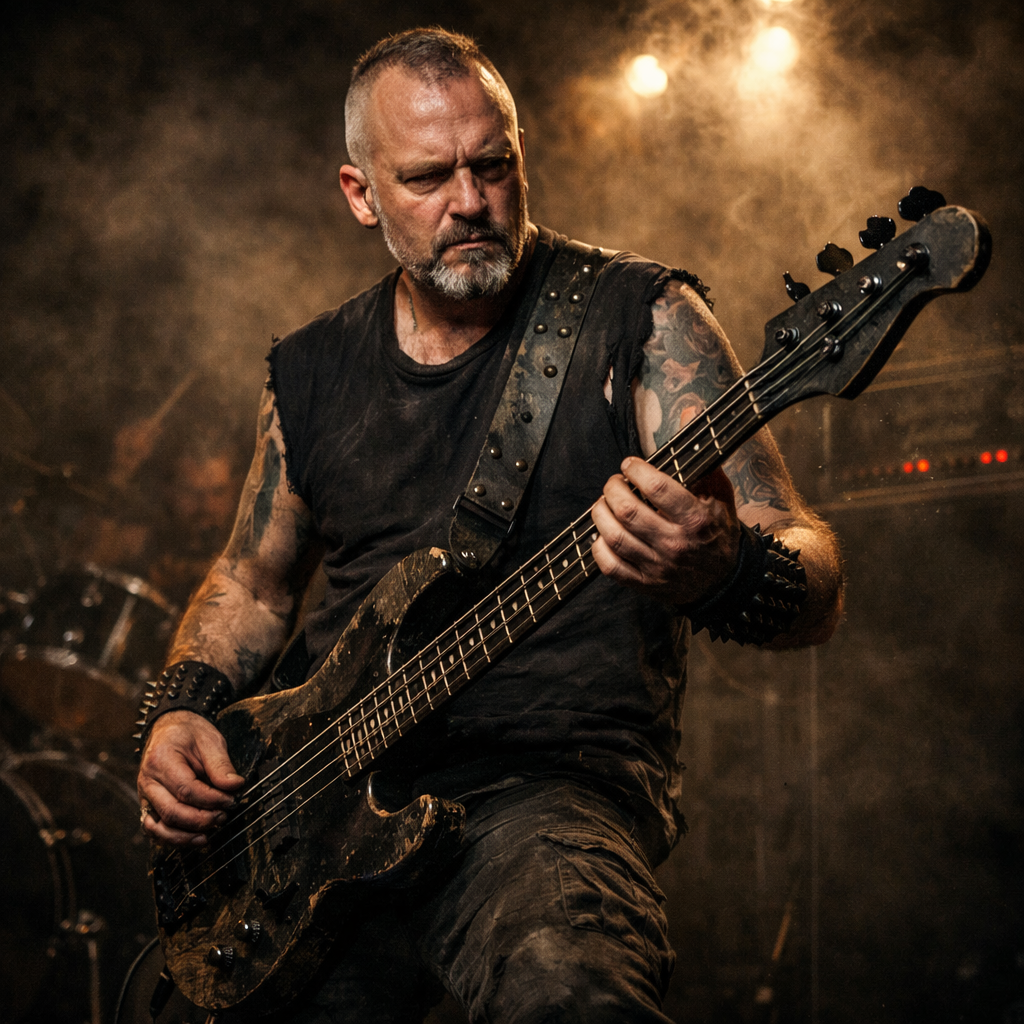
Born in 1970 in Wakefield, West Yorkshire, Mark “Rot” Ellison is the bass player of Insane Overlords and the man responsible for dragging the band’s sound deeper into the dirt.
His tone is thick, distorted, and unrelenting — less clean low end than controlled decay, less support than infestation. Where others might aim for clarity, Rot aims for pressure. He fills the gaps, muddies the edges, and gives the band the kind of bass presence that feels like rot spreading through the foundations.
“Rot doesn’t sit under the sound. He infects it.”
Growing Up in Wakefield
Mark grew up in Wakefield, shaped by West Yorkshire grit and by something more personal: limited hearing that made his relationship with sound different from the start.
Where many people experience music first through detail, Mark learned early to experience it through weight, vibration, movement, and force. He did not come at sound in the same way as everyone else, and in time that difference became part of what made him such a distinctive musician.
He was never interested in neatness for its own sake. He gravitated toward what could be felt as much as heard — the physical side of music, the body of it, the push in the chest, the throb in the floor, the sense that sound could live in bone and air at the same time.
That shaped not just the way he listens, but the way he plays.
“For Rot, music was never only something to hear. It was something to feel taking hold.”
How He Entered Insane Overlords
Mark found his way into Insane Overlords because the band needed someone who understood that bass is not there simply to sit politely in the background. It needed someone who could thicken the entire sound, make it feel heavier, dirtier, and more dangerous.
Rot brought that immediately.
He did not approach bass as a tidy low-end instrument meant only to hold down the bottom. He approached it like a spreading pressure source — something distorted, physical, and alive inside the machinery of the band. Once he locked in with Iron hand's riff weight, Warhammer’s force, Hex’s cutting edge, Ash’s atmosphere, and Grave’s voice, it became obvious how essential he was.
He did not join Insane Overlords to decorate the songs.
He joined them to drag them lower.
How He Became “Rot”
The name “Rot” came from the sound itself.
Mark built a bass tone that felt filthy in the best possible way — thick, corroded, degraded, and crawling through every part of the mix like something slowly breaking down from within. It was not just distorted. It sounded like it was rotting in real time, and making everything around it decay with it.
That was the name right there.
Not clean.
Not polished.
Not interested in behaving itself.
“Rot” stuck because it described exactly what his playing did to the band’s sound.
“His tone didn’t just distort the songs. It made them decay from the inside.”
Writing in Weight and Texture
As a writer and player, Mark works from feel first.
Because of his hearing, his relationship with music has always been physical. He responds to mass, movement, placement, and the way sound sits in space. That gives him a unique instinct inside the band. He is not chasing flashy bass parts or technical clutter. He is listening — and feeling — for what the song needs in order to become heavier, thicker, and more complete.
His bass lines are built to support, but never passively. They reinforce the impact of the riffs, deepen the atmosphere, and add a layer of grime that gives Insane Overlords their low-end character. He knows when to lock in tightly, when to let a note drag, when to let distortion bloom, and when the right part is simply the one that makes the whole room feel slightly worse in the best possible sense.
Working with the others, Rot is a crucial part of the band’s internal pressure system.
Iron hand brings the core riff structure.
Warhammer drives the physical force.
Hex cuts through the top with eerie leads.
Ash reshapes the air around the sound.
Grave delivers the final blow out front.
Rot fills the spaces between all of them with dirt, depth, and momentum.
“Rot writes bass the way damp gets into walls — quietly, thoroughly, and impossible to ignore once it’s there.”
On Stage: Playing by Feel
On stage, Mark plays in a way that is entirely his own.
He removes his hearing aids before performing and finds the best place on stage to feel the music properly through the floor, the cabinets, the air, and the physical movement of the band around him. He plays largely through instinct, vibration, and force — reading the set not only through what reaches him sonically, but through what lands in the body.
It is one of the most distinctive things about him as a performer, and one of the reasons his connection to the bass feels so direct.
As Mark puts it:
“If it’s loud enough, you don’t need ears — you’ve got bones.”
That line says a great deal about him.
He is not battling the music.
He is inside it another way.
And that is why, on stage, Rot feels less like a player following the sound and more like part of the structure that is generating it.
“Rot doesn’t just hear the set. He stands inside it and lets the bones do the rest.”
Off Stage: Quietly Sharp
Off stage, Mark’s hearing means he does not always catch every conversation, every passing comment, or every stray line in a noisy room.
But when he does catch it, he has a dry wit sharp enough to flatten the whole place.
He is not the loudest in the band, nor the most visibly theatrical, but he has the kind of humour that lands hard because it arrives without fuss. One line, perfectly timed, and the room is gone.
That sharpness suits him. So does the understatement.
Off stage, Rot is grounded, observant, and often funnier than people expect if they are paying enough attention.
“He may miss half the room, but he only needs one line to kill the other half.”
Quick Profile
Full name: Mark Ellison
Stage name: Rot
Born: 1970
From: Wakefield, West Yorkshire
Role: Bass
Known for: Thick distorted low end, physical approach to performance, filthy bass tone
Writing style: Feel-led, structural, textural, heavy
On stage: Removes hearing aids, finds the right place to feel the music, plays through vibration and instinct
Off stage: Dry wit, observant, understated, sharper than people realise
Final Word from IOM
Every heavy band needs low end.
But low end alone is not enough. It needs character, filth, and a player who understands that bass can be less a foundation than a contamination.
That is Mark “Rot” Ellison.
He brings the decay, the depth, and the kind of physical connection to sound that cannot be faked. He does not experience music the same way as everyone else, and Insane Overlords are heavier because of it.
“Rot finds the place where sound stops being heard and starts being lived in.”
In Conversation with Mark “Rot” Ellison
Wakefield, low end, vibration, and hearing the music another way
There are players who hear every detail.
Then there are players like Mark “Rot” Ellison, who built their whole relationship with music through something deeper and more physical.
Born in 1970 in Wakefield, West Yorkshire, Rot came up with limited hearing, and that difference shaped the way he experiences sound, writes bass parts, and performs live with Insane Overlords. On stage, he removes his hearing aids and plays largely through feel, vibration, and instinct. Off stage, he might not always catch every word in a room — but when he does, his dry wit tends to finish the conversation in one line.
IOM sat down with Rot to talk about growing up, finding heavy music, joining the band, building his rotting bass tone, and why sometimes bones tell you more than ears ever could.
“Some players listen for notes. Rot listens for pressure.”
Growing Up in Wakefield
IOM: You were born in 1970 in Wakefield. What was growing up there like for you?
Rot:
Wakefield was solid. Straightforward place, proper people. It gives you a certain toughness without making a song and dance about it. You get on with things. That sticks with you.
IOM: You also grew up with limited hearing. How did that shape the way you experienced music early on?
Rot:
It made it different, obviously. I couldn’t always take things in the same way everyone else seemed to. But music still got through — just not always through the same door. I felt it as much as I heard it. Probably more, if I’m honest. Bass, drums, anything with real physical weight, that always made sense to me.
IOM: Did that difference ever feel like a barrier?
Rot:
Sometimes, but not in a way that stopped me. You adapt. You figure things out. You find your own route into it. In some ways it probably pushed me closer to the side of music that mattered most to me anyway — the force of it.
“Music still got through — just not always through the same door.”
Finding Bass
IOM: Why bass?
Rot:
Because bass is physical. You don’t just hear it, you feel it. It moves air. It sits in the body. That always made more sense to me than anything too delicate or overcomplicated.
IOM: Was tone always as important to you as the notes themselves?
Rot:
Absolutely. Probably more important half the time. A clean note can still say nothing. The right tone tells you what sort of world the song lives in. I wanted something filthy, thick, and wrong in the right way.
“A clean note can still say nothing.”
Joining Insane Overlords
IOM: How did you end up in Insane Overlords?
Rot:
It came together naturally. The sound was there, the people were right, and there was room for the bass to be more than just polite support. That mattered. I could hear — and feel — where I could fit into it.
IOM: What did you feel you brought to the band?
Rot:
Dirt, probably. Depth. Weight. The part of the sound that gets in underneath everything and starts pulling it downward.
IOM: Was it obvious early on that the fit was right?
Rot:
Pretty much. Once Iron hand's riffs, Warhammer’s drums, Hex’s leads, Ash’s atmosphere, and Grave’s voice all started locking in, it was clear what the bass needed to do. I just had to make it filthier.
“I just had to make it filthier.”
Becoming “Rot”
IOM: How did the name “Rot” come about?
Rot:
The tone. It sounded like it was decaying while it was happening. Not just distorted — actually rotting. Once that got said out loud, there wasn’t much point pretending the name was going to be anything else.
IOM: Did you know that was the sound you were after?
Rot:
Not in a neat, planned-out way. I just knew I didn’t want anything too tidy. I wanted a sound that felt lived in, damaged, slightly poisonous. Something that made the whole band seem heavier by making it seem less healthy.
“I wanted a sound that made the whole band seem less healthy.”
Writing and Working With the Others
IOM: What’s your writing process like?
Rot:
Feel first. Always. I want to know where the song sits physically. Where the weight is. Where the gaps are. Then it’s about finding the part that holds it together without cleaning it up too much.
IOM: So you’re not thinking about flashy bass parts?
Rot:
No. Wrong band for that, really. If a bass line helps the song by staying simple and filthy, that’s what it should do. I’m not trying to impress anyone with finger gymnastics.
IOM: How do you work with the others as songs take shape?
Rot:
Iron hand gives you the structure. Warhammer gives you the drive. Hex puts the strange light through it. Ash shifts the atmosphere. Grave brings the voice and shape of the thing out front. I’m there to make sure the whole lot has enough body and grime to feel dangerous.
“Feel first. Always.”
Playing Live by Feel
IOM: One of the most distinctive things about you live is that you remove your hearing aids on stage. How does that change the way you play?
Rot:
It strips things back to what matters. I’m not trying to catch every tiny detail. I’m finding the best place on stage to feel the music properly and working from there. You learn where the cabinets hit right, where the floor speaks back, where the body of the sound sits.
IOM: So the stage becomes something you physically navigate?
Rot:
Exactly. It’s about placement, vibration, memory, instinct, and trust in the band. Once you know the songs well enough, you don’t need to chase every sound in the usual way. You know where you are in it.
IOM: You once said, “If it’s loud enough, you don’t need ears — you’ve got bones.” That feels like it says a lot about your whole approach.
Rot:
Well, it’s true. If the music’s got enough weight, your body catches up. Bones are honest. They don’t pretend.
“If it’s loud enough, you don’t need ears — you’ve got bones.”
Off Stage
IOM: Off stage, does your hearing affect how you move through conversations and rooms?
Rot:
Of course. I don’t always catch everything, especially if there’s a lot going on. That’s just reality. You get used to piecing things together, reading people, choosing your moment.
IOM: But when you do catch the moment, you’re known for a fairly lethal dry wit.
Rot:
That’s what I’ve heard.
IOM: Fair.
Rot:
You don’t need to talk constantly if one line will do the job.
“You don’t need to talk constantly if one line will do the job.”
Perspective and Identity
IOM: Do you think having a different relationship to sound has shaped the musician you became?
Rot:
Definitely. I think it made me trust feel more. Trust weight more. It probably kept me away from overthinking things too much. If it lands properly, it lands. If it doesn’t, you know.
IOM: What does Insane Overlords mean to you?
Rot:
A proper band. Real weight. Real people. A sound that doesn’t apologise for itself.
IOM: Last word — who is Mark “Rot” Ellison?
Rot:
A bloke from Wakefield making things heavier one bad decision in tone at a time.
“A bloke from Wakefield making things heavier one bad decision in tone at a time.”
Closing Note from IOM
Mark “Rot” Ellison does not approach music from the same place as most players, and that difference is exactly why he matters so much to Insane Overlords.
He plays by feel, trusts vibration, and understands that the heaviest sounds are often the ones that move through the body before the mind has a chance to catch them. Add to that a bass tone that sounds actively unhealthy and a wit dry enough to cut steel, and you have one of the band’s most singular presences.
He hears enough.
He feels the rest.
And the songs are filthier for it.